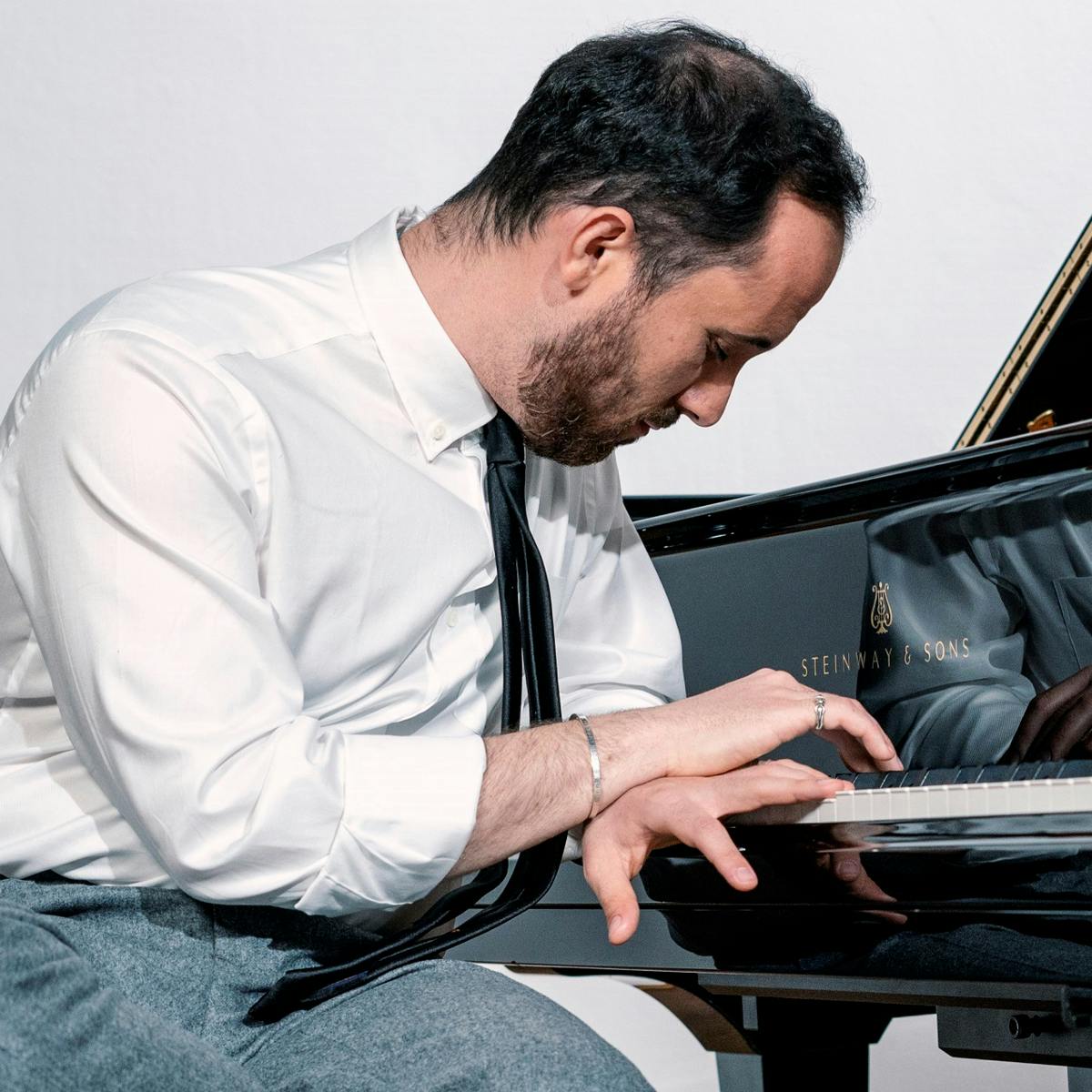
Photo credit: Felix Broede
Concert Review: Igor Levit, 7 March 2024
Igor Levit's recitals are always a phenomenon—as is Mr. Levit himself.
He is intellectual: he champions new works, touring contemporary masterpieces like Frederic Rzewski's hour-long "The People United Will Never be Defeated!", but also played all 32 Beethoven sonatas some years ago in a summer-long, eight-recital series in Salzburg.
He is laid-back: during the early days of Covid-19, his series of hauskonzerte featured him in sweaters and jeans streaming from his living room—a series which brought him worldwide acclaim.
He is progressive: his website bio reads, simply: "Citizen. European. Pianist."
In recital, these details fade away, and we are left with Igor Levit, artist. Last season, your correspondent saw him play Shostakovich's 24 Preludes and Fugues, a feat taking three hours and never before done in Carnegie Hall; the recital stands as one of the most impressive in your correspondent's decade of concertgoing experience. In this recital, he set himself a different challenge: conjuring orchestral sonority, color, and range from one piano and his two hands.
The recital featured Hindemith's "Suite 1922," a riff on Baroque suites that incorporates dances old and new; Mahler's titanic Adagio from his Symphony no. 10, transcribed by Ronald Stevenson; and Beethoven's Symphony no. 3, "Eroica," transcribed by none other than the greatest pianist of all time, Franz Liszt. (This recital gave the Mahler transcription its Carnegie premiere and the Beethoven transcription only its second performance: Mr. Levit the progressive still peeks through.)
Mr. Levit juggled these colossal, unwieldy works without apparent strain, moving from the bitterness of the Suite to the weltschmerz of the Adagio to the heroism of the "Eroica" as if they were the most natural trio of works. His startlingly vulnerable Mahler made for a performance almost as convincing as that of an orchestra, which your correspondent—a diehard Mahlerian—means with the greatest of praise. And for a pianist not known for his technique—unlike, say, Daniil Trifonov or Yuja Wang—he pulled off the Suite and "Eroica" with astounding power and flair.
* * *
In perfect honesty, your correspondent doesn't know what Mr. Levit wanted to say with the Suite. But he is confident it isn't what the drivel in the program notes said. The recital is putatively part of a series called "The Fall of the Weimar Republic: Dancing on the Precipice;" the notes call the Suite "democratic" in its welcoming a "broader, less culturally elite audience." But today, sarcastic parodies of dances popular a century ago and an ocean away feel much more elite (read: elitist) than the straightforwardly welcoming, widely beloved classics so maligned as "old white guy music" in recent times.
Which is not to say that it wasn't fun—it was great fun, in the way rollercoasters that spin their riders around or drop them precipitously are fun. Recitals often have brief suites or standalone works as introductions; if so, the Suite was tantamount to an amuse-bouche of durian salad. What the suite was not is a warm-up: from the first note, Mr. Levit played with spirit, coyness, and ferocity. He frequently rose slightly to hammer down even harder than just his arms would allow, while in calmer moments he would lightly conduct himself, à la Glenn Gould. Among the pieces—"Nocturne," "March," and others—the only piece still recognizable as such, "Ragtime," had a manic energy, coming off like the performance of a brilliant but very drunk breakdancer.
After generous applause and no trip backstage, Mr. Levit settled down for the Adagio. This transcription is one of the most unusual: long, naked string melodies dominate the Adagio, the only movement of Symphony no. 10 near completion at the time of Mahler's death; superimposed on the piano, with its fading, unsustained sound, the music can feel austere, even impoverished.
But playing it is not impossible—it just requires a deep musical sensibility that's only describable as metaphor, "breath" or "space" or "freedom" or "direction." This sensibility is essential to Mahler's works more than any other, and no pieces require it more than his late works, the Symphonies no. 9 and 10, full of the slowest, most aching music ever written. Conductors spend their entire careers developing this sensibility; to attempt Mahler 10 in Carnegie Hall's vastness on the piano could be considered as doomed as catching water in a colander.
The first minute of the piece, originally a somber solo viola melody, became a whispered prose-poem: a word here, a phrase there, more felt than understood. From there, the first chord, the opening of the first theme, sucker-punched the audience with major-keyed sorrow, like smiling through tears on the day one pulls a loved one’s life support (and of course it’s a beautiful day outside). The second theme was more down-to-earth, discursive; Mr. Levit’s thrumming trills, plucked bass, and wry, understated melody made for a coherent, thoughtful performance.
As the piece developed, Mr. Levit consistently produced a "big" sound, such a rare achievement. A big sound is not loud, but powerful; a big sound can be hushed, but is sure to be heard by every audience member. And when a big sound happens to be loud—well, it approaches the echo of a gong or the peal of bell.
After a shuddering climax of dissonant chords and churning tremolos, the music lingers, unwilling to perish. These are vulnerable minutes, liable to drag on or dissipate in less confident hands. Mr. Levit—despite emphysemic coughing in the front rows—conjured long fibers of decrescendi and sparkling, empyrean chords. And when the music finally ended, he held his hypnotized audience from their applause until he himself sat back—a rare feat, considering the brashness and impatience of many New York concertgoers.
* * *
This itself would have been a complete recital, but there was a full second half—the "Eroica"—yet to come, and what a second half it was. The Beethoven-Liszt transcriptions are difficult—extremely difficult. To give a sense: according to Caleb Hu, inveterate cataloguer of the most difficult works in the repertoire, the fearsome "Feux Follets" etude from Liszt's set of Transcendental Etudes is the tenth-most difficult work by the composer; "Eroica" ranks third. (His transcription of Beethoven's Ninth ranks first.)
Your correspondent took many mental notes during the performance; he could go on about the storms of octaves, the coruscating arpeggios, the deathly funeral march. And it's a copout for anyone, but especially a reviewer, to say, "You had to have been there." But: you had to have been there. Mr. Levit seemed to have grown an extra two hands during intermission, and another brain as well to make them as dexterous as his original two. His oneness with the music—his ease of playing, his joy at playing, his love for playing—poured out from the first two chords to the cascade of octaves spanning the entire keyboard at the end. And when he stood to receive his applause, your correspondent, in the center of the third row, smiled widely at him—might even have made eye contact with him, Igor Levit, music made flesh.
After multiple standing ovations, Mr. Levit sat down and made a dry joke: "There are eight more Beethoven symphonies—but none for today." (There will be one, the Seventh, at his next recital.) Instead, he played his "most favorite intermezzo," and your correspondent's favorite as well, Brahms's op. 117, no. 1. In E-flat Major like the "Eroica," but a world away from it: glowing, golden-brown warmth. No piece would have better concluded the recital.
[Written 2024]